|
|
|
Our Newly Published
Long-Term
Study Shows 98% Cure Rate for Early Stage Cancer!
|
|
|
|
|
|
Wall Street Journal:
IMRT
works as well as Proton Beam and costs less!
|
|
|

|
|
|



2020 Castle Connolly Regional Top Doctors®
2020 America's Most Honored Doctors 2020 - Top
10%
2019 Top Doctor - Jacksonville Magazine
2019 Castle Connolly Regional
Top Doctor 5th Anniversary
2019 Castle Connolly Regional Top Doctor
2019 Castle Connolly Top Doctors
2019 America's Most Honored Professionals Top 1% Award
2019 Vitals®
On-Time Physician Award
2019 Vitals® Patient's Choice Award
2018 America's Most Honored Professionals - Top
1%
2018 Compassionate Doctor 5 Year Honoree
2018 Castle Connolly Regional
Top Doctor
2017 Jacksonville Magazine - Top Docs
2017 America's Most Honored Professionals 2017 - Top 5%
2017
Castle Connolly Regional Top Doctor
...
LEARN MORE...

2020 Castle Connolly Regional Top Doctor 2020
Awarded America's Most Honored Doctors - Top 10%
2019 Top Doctor - Jacksonville Magazine 2019 Castle Connolly Regional Top Doctor 2019
America's Most Honored Professionals Top 5%
2018 America's Most Honored Professionals - Top 5%
2018 Castle
Connolly Regional Top Doctor
2017 America's Most Honored Professionals - Top 10%
2017 Castle Connolly
Regional Top Doctor
...
LEARN MORE...
|
|
|
Welcome to Jacksonville's Florida Proton Therapy for Prostate Cancer Resource Center
Every year 240,000 men will be diagnosed with prostate cancer, making it one of the most common cancers in the United
States. With improvements in early detection and recent advances in non-surgical treatment, men
can now be cured of this disease and still maintain an excellent quality of life. Our recent long-term
studies have shown that more than 98% of men with early stage prostate cancer can be cured with a simple one-time out-patient
prostate seed implant (brachytherapy), results far superior to proton beam radiation and other treatment modalities.
Proton beam radiation is an older technology that has
actually been in use since the 1950s. Rather than treating cancer with photons, as occurs with IGRT, men are simply treated
with a different type of radioactive particle, called protons. Because it is new to north Florida, some men have been interested
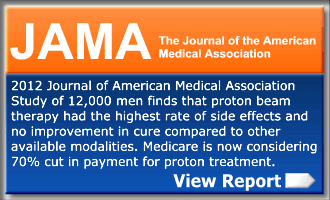
in comparing proton beam to newer and more precise forms of treatment, such as prostate Seed Implants and IMRT-IGRT. In April 2012, one of the largest studies of prostate cancer outcomes in the US was published
in the prestigious Journal of the American Medical Association. The researchers looked at 12,000 men treated with radiation
for prostate cancer in the US and found that IMRT was associated with the BEST outcomes. Proton therapy had 31% higher gastrointestinal
toxicity than IMRT and no discernible benefit when compared to other modalities (JAMA 2012). The safety and effectiveness of seed implants and IGRT has been thoroughly studied in hundreds
of scientific papers, with excellent long-term 15 year outcomes. In contrast, after 50 years of proton use, there is still
remarkably very little published data on its cure rates and complications. There are no studies reporting outcomes beyond
5 years after treatment with proton beam. There are no studies showing long-term potency or incontinence rates. This data
is critical for men with a long life expectancy. A review of every published study on proton beam radiation shows that patients
suffer 20-40% higher cancer recurrence rates, are more likely to develop long term complications, and may be at a greater
risk of developing new cancers than those treated with seed implants. In addition, proton beam therapy is time consuming (9
weeks of daily treatment are required), costly (more than $120,000), and not covered by many insurance plans. One
of the oldest and most experienced proton centers in the world is located at Harvard's Massachusetts General Hospital. A recent
analysis there showed proton treatment actually delivered higher doses of radiation to the normal tissues around the prostate
than treatment with IMRT (Trofimov et al IJROBP 2007). As a result, their institution now favors treating prostate cancer
with seed implants or IMRT, instead of protons. For the above reasons, most major cancer centers throughout
the world have decided not to pursue the less effective proton beam technology and instead have focused their attentions on
more innovative and successful seed implant and IMRT-IGRT programs for the optimal treatment of prostate cancer.
 BACK TO TOP BACK TO TOP
-------------------------------------------------------------------------------------
Proton Radiation - Increased Recurrence Rate
Will seed implants improve
my likelihood of being cured?YES! Our cure rates with seed implants are 20 to 40%
better than the best results ever published with proton beam therapy. Seed implants have the unique advantage of having the
radiation placed directly into the cancer. The radiation is concentrated where it needs to be, without the unnecessary high
dose radiation of areas outside the prostate, as occurs with proton therapy. (see chart below)
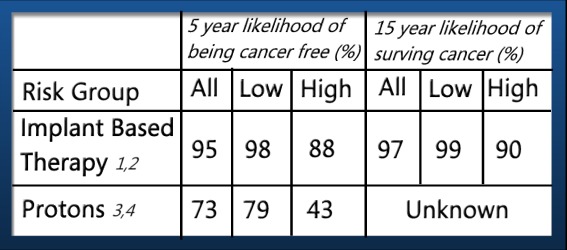
A recent study from the largest proton
center in the country at Loma Linda, California reported that for 1,225 men with prostate cancer, the 5-year success rate
with proton therapy was only 73%. For those with high risk disease, the success rate was only 43% (Slater, 2004). Unfortunately, there have not been any studies looking at outcomes more than 5 years following proton beam treatment. This
is in comparison to our own recently reported long term study showing at 10 years, a 95% success rate with seed implants for
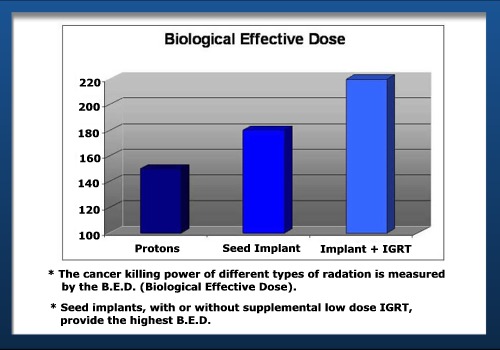
intermediate risk disease, and 83% success rate for high risk disease (Terk 2009). With the seeds being
placed directly in the prostate, higher doses of radiation can be given to the cancer, resulting in a much higher BED (biologically
effective dose). The 20-50% higher BED seen with seed implants results in much greater cancer killing. Seed implants allow
the ultimate concentration of radiation directly in the prostate, while still keeping surrounding areas at the lowest dose
possible.
|
Proton Radiation - Increased Side Effects
Will I have fewer long term side effects with a seed implant?YES - because high dose proton beam radiation is delivered externally from a machine, the radiation
still must enter the body from the outside and pass through organs like the bladder and rectum and hips to reach the prostate,
causing much greater side effects than seed implants. A study from a leading proton facility showed that following proton
radiation, 41% of men had long-term rectal bleeding and 47% had long-term bleeding with urination (Gardner, 2002). Long-term incontinence rates after proton radiation still remain unknown. In contrast
to proton beam radiation, long term side effects are very rare with seed implants. Using an intra-operative dosimetry technique,
the likelihood of the seeds migrating outside the prostate is less than 0.4%. Urinary incontinence occurs in less than 1%
of men following a seed implant. Other severe urinary problems are also very rare. (Zelefsky, 2007)
Will seed implants allow for improved preservation of my erectile function?YES - The best erectile function preservation rates are obtained with seed implants. By pinpointing
the seeds directly in the prostate, there is minimal effect on nerves that help control erections. Studies show that up to
90% of men maintain their erectile function after a seed implant (Cesaretti, 2007). Erectile function has never been evaluated after proton beam radiation. Because proton radiation needlessly treats outside
the prostate where the nerves reside to a high dose, much greater impotency rates are expected.
|
|
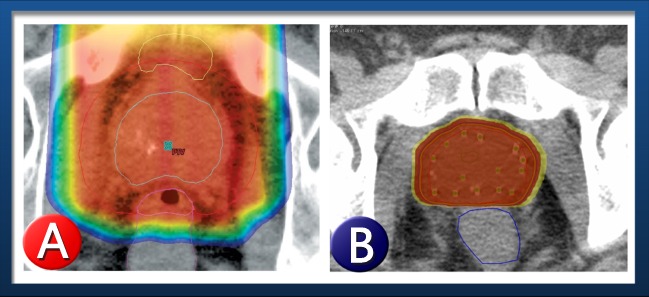
A. A dose map of a prostate being treated with
protons shows the excess radiation deposited outside the prostate. This is what causes the higher side effects.
|
B. A similar dose map of a prostate being treated
with a seed implant shows no excess radiation outside the prostate, as the seeds radiate the prostate from within.
|
|
BACK TO TOP ------------------------------------------------------------------------------------------------------------
Proton Radiation - Dangers
Why is there a high risk of proton radiation causing a new cancer to develop?Of great concern, the renowned radiation biologist Dr. Eric Hall reported that the physics of proton
radiation delivery causes excessive neutron contamination in the patient’s body. Neutrons are dangerous
nuclear particles that can damage normal organs. They are known to increase the likelihood of developing potentially life-threatening
secondary cancers. (Hall, 2007). This risk of neutron contamination is much greater with proton radiation than with either IGRT or seed
implants.
BACK TO TOP ------------------------------------------------------------------------------------------------------------
Proton Radiation - Salvage Treatment
What are my treatment options if I have a recurrence of my cancer after proton
beam radiation?The Florida Center for Prostate Care has the largest published experience
in the world using seed implants to treat patients with recurrent cancer after prior radiation treatment. Several simple tests
and our review of your records help determine if you are a potential candidate for this highly specialized treatment.
BACK TO TOP ------------------------------------------------------------------------------------------------------------
|
|
Questions to Ask Your Doctor if You Are Considering Proton Radiation
Men with prostate cancer deserve answers clearly supported by evidence published in medical journals.
4 questions you MUST ask your proton doctor if you are considering proton beam treatment:1. Have you personally published your 10 year proton beam results in a medical journal or presented them
at an international conference? 2. For my stage of prostate cancer, what is the published
likelihood that I will be cancer free 10 years after proton beam radiation? (please show me the articles) 3. Why do experts report my risk for developing a new secondary cancer is greater after proton beam radiation than
prostate seed implants? 4. What is the 10 year published likelihood of maintaining my
erectile function and urinary control (continence) after proton beam radiation?
|
|
BACK TO TOP ------------------------------------------------------------------------------------------------------------
World Class Prostate Cancer Experience
The Florida Center for Prostate Care has physicians dedicated to the treatment of all stages of prostate cancer, including recurrent cancer after proton beam
radiation. Our caring team has treated more than 10,000 men with prostate cancer,
and has performed more than 5,000 prostate seed implants, making us one of the world's premier centers. We have patented medical
devices and published extensive research in medical journals. Based on our experience and reputation, we have trained hundreds
of doctors across the United States, Europe, Asia, and Africa on our Procision™ seed implant technique. All of our centers
also offer image guided radiation therapy (IGRT), the newest technology for the most precise delivery of external radiation
therapy. Our experience will allow you to feel confident that you have obtained the best possible care anywhere in the world. Cancer Experts
We have board certified
specialists on hand for all other types of cancer as well, including lung, breast, and colon-rectal. We have one of the largest,
most comprehensive radiosurgery programs in the world. We have been continuously caring for cancer patients throughout the
area since the 1950's. Our Primary Goal
Our primary goal is to provide you with comprehensive and leading edge cancer care in a compassionate and friendly
environment.
|
2025
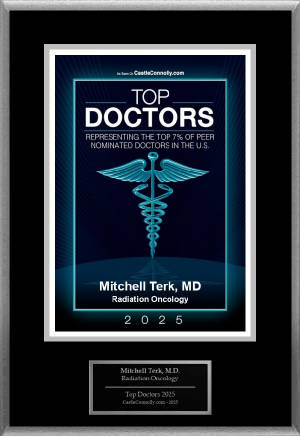
Mitchell Terk, MD: Awarded Castle Connolly Top Doctors - Top 7% 2025
|
2025
Dr. Mitchell Terk: America's Most Honored Doctors 2025 - Top 5%
|
2024
Awarded Castle Connolly Top Doctors – 2024
|
|
2025
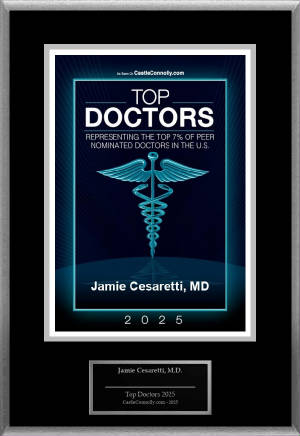
Awarded Castle Connolly Top Doctors - Top 7%
|
2025
Dr. Jamie Cesaretti: America's Most Honored Doctors 2025 - Top 1%
|
2024
Jamie Cesaretti, MD: Awarded Castle Connolly Top Doctors – 2024
|
2024
Dr. Jamie Cesaretti Awarded America’s Most Honored Doctors 2024 –
Top 5%
|
|
|
Dr. Jamie Cesaretti Named as 1 of 3 Best
Oncologists in Jacksonville.
LEARN MORE
|
BACK TO TOP ------------------------------------------------------------------------------------------------------------
|